Electronic check
The eligibility request returns the skeleton: coverage status, annual maximum, deductible and class percentages.
Dental insurance verification that doesn't stop at “active”
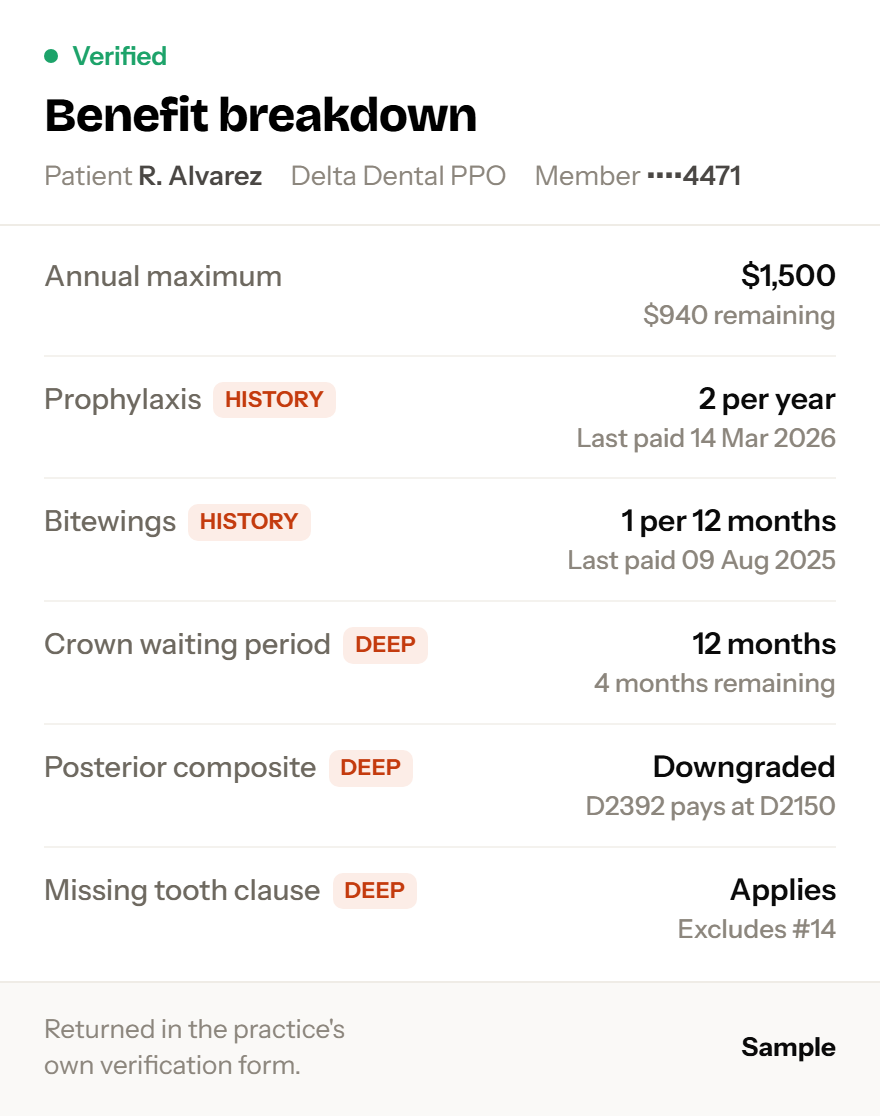
Frequencies, waiting periods, downgrades, remaining maximum, and the date each service was last paid. The system runs the eligibility check, reads the portal, places the payer call and sits through the hold, then writes every field into your own verification form. Nobody on your team touches a phone.

These are practice staff describing the job, in public, in their own words. None of it is unusual and all of it is billable time.
“If you have to spend hours a day on the phone on hold waiting for Delta, it's kind of mind numbing.”
 A practice administrator, describing the verification day
“Most claims are very simple to submit. Insurance verification and copay estimates take a lot more of your time.”
 Said by someone arguing against outsourcing billing
“We couldn't find anyone to hire with dental insurance experience, so we are muddling along.”
 An office manager after a failed hire
Real-time eligibility is a screening tool. It tells you a plan exists. It does not tell you whether this patient has already used the benefit you are about to schedule, and that is the part that comes back as a denial.
Response ends here. Everything below this line has to come from a payer portal or a phone call, which is why your coordinator is making one.
The electronic check and the portal take seconds and every vendor does them. The phone call is where the fields that come back as denials live, which is what makes it worth the most. It is the step most vendors leave to your staff.
The eligibility request returns the skeleton: coverage status, annual maximum, deductible and class percentages.
The payer portal is read for what the electronic response omits: frequencies, service dates, remaining benefit.
Where the payer publishes nothing, the system calls and sits through the hold. Nobody at your desk waits.
Everything lands in the form your team already uses, each field marked by where it came from.
Your coordinator keeps doing the verifications exactly as they do now. The software runs the same ones in parallel, and at the end of the week you put the two side by side. Nothing in your schedule depends on it being right, which is the point.
Six fields. The agreement comes back the same day, and the week starts whenever you say.
The category is old, the large players were bought by the distributors, and the complaint practices make about them is consistent enough to be worth quoting.
The same outsourced feel, with communication issues and limited results.A practice manager on the incumbent verification services, in a public dental forum
The first question every office asks is where the data goes. The answer is short: US servers, a US phone line, and a business associate agreement signed before you send a single name. It is the same one-page agreement you have signed with every vendor that touches a chart.
Servers in the US, the payer call placed from a US line, records encrypted at rest. No overseas team reads a chart and nothing leaves the country at any step.
The agreement goes out before you send a single patient. Read it, sign it, or decide against the week. Nothing has moved either way, and it has cost you nothing.
The system will not place a call naming a patient unless the agreement is on file. A person checks the paperwork and turns it on. It is not a default setting.
A flat monthly plan per practice, sized to how many verifications you run. The quote comes after you have seen a week of the work rather than before, because the number means nothing until you know what is coming back.
It is not a percentage of collections and it is not per seat.
A signed business associate agreement, your NPI and your tax ID. The payer asks for the last two to authenticate the caller as the provider, so there is no route around them.
Then, per patient: member ID, date of birth, carrier and the planned procedure. The same details your coordinator already gathers before picking up the phone.
Whatever you run. Dentrix, Eaglesoft, Open Dental, Curve, Denticon, Carestream and the rest: the breakdown comes back in your own verification form, filled, in the layout your team already reads. Send a blank copy of it and that is what comes back.
Where the electronic check and the portal answer everything, minutes. Where a payer has to be called, it takes as long as that payer's hold queue takes, and some of them are genuinely long.
The difference is that the system does the waiting. Your coordinator's morning is not the thing being spent.